Platform.
The governed stack, in detail.
For readers who already know what they need, this is the depth behind it.
The daily view
What your team opens in the morning.
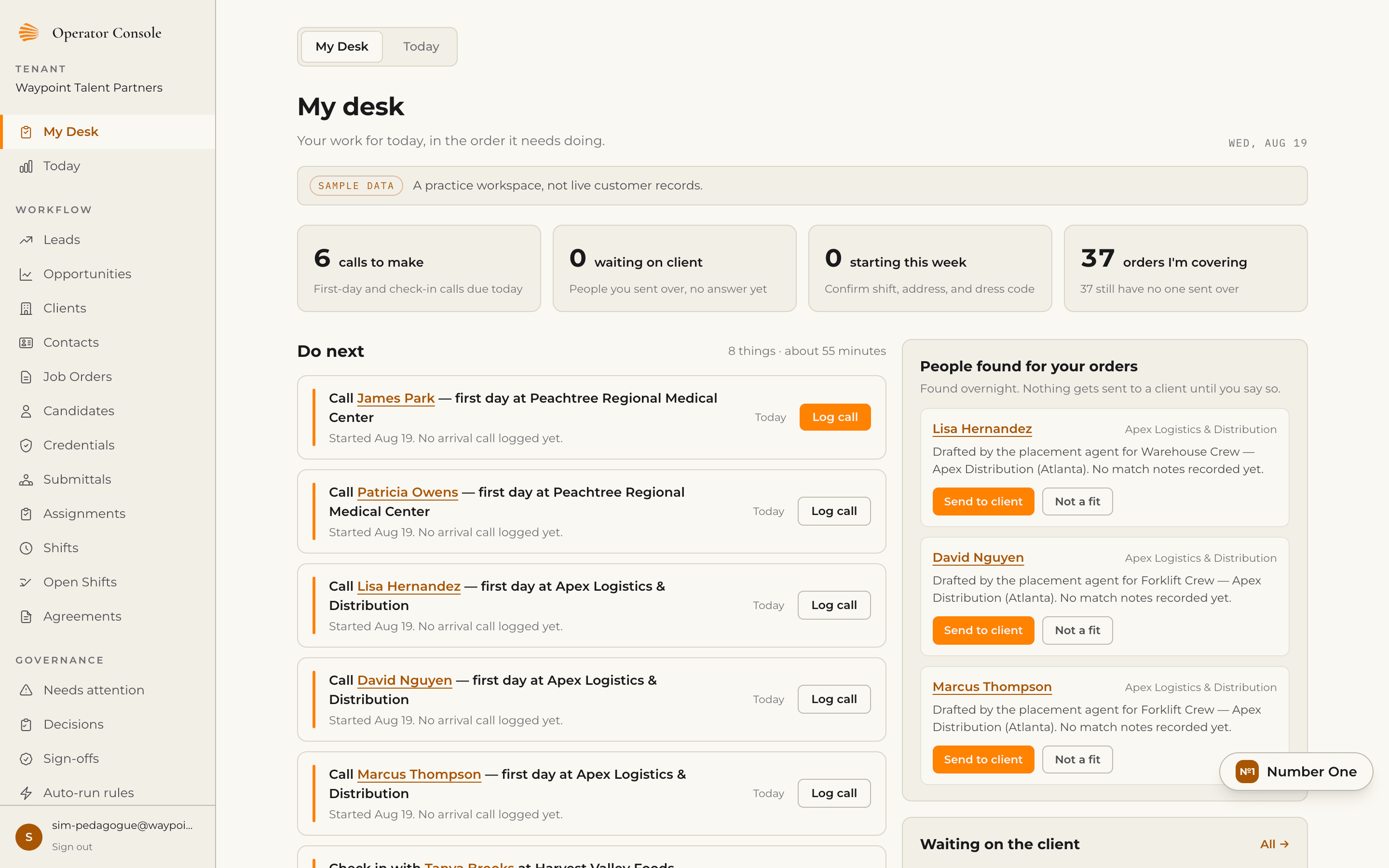
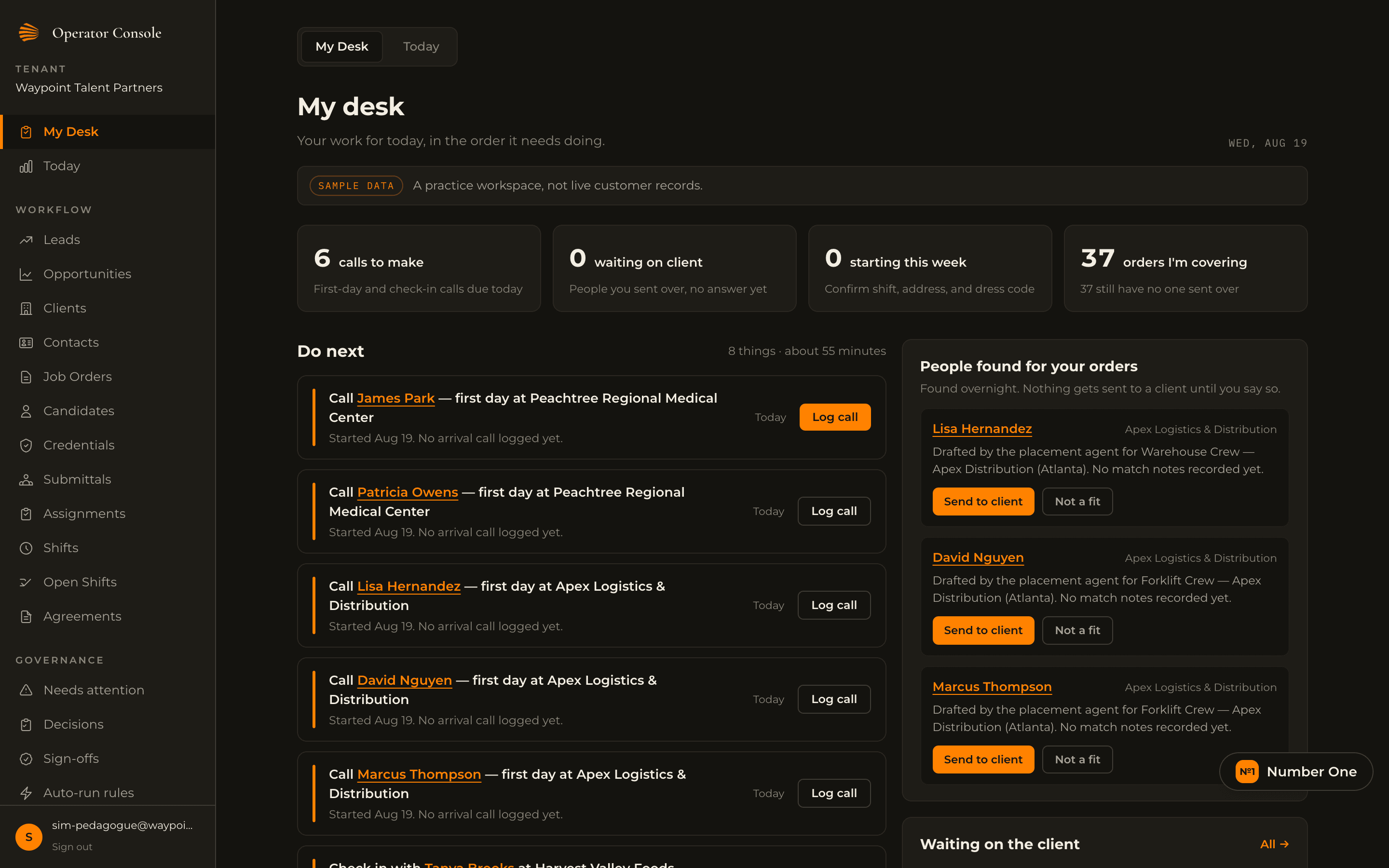
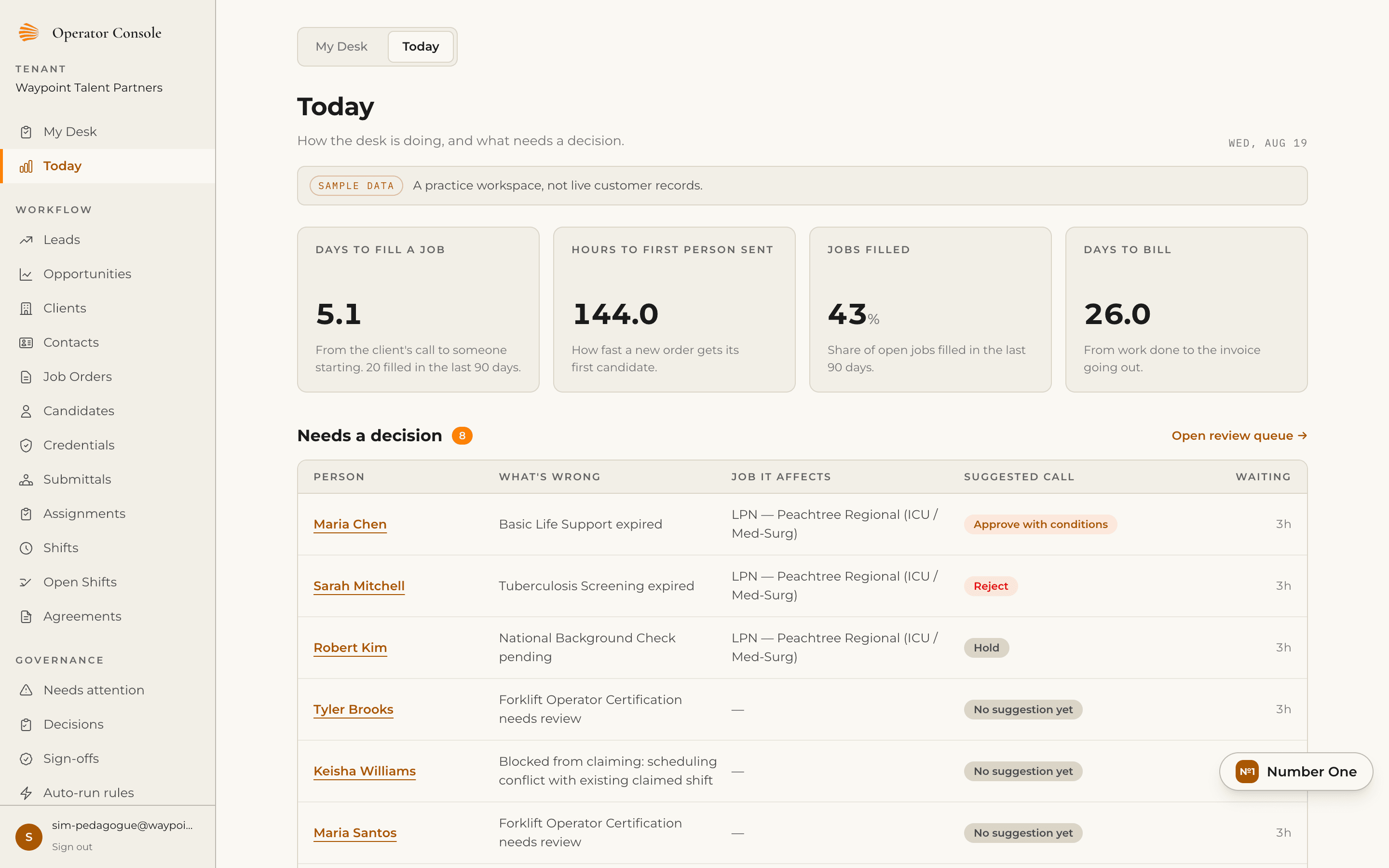
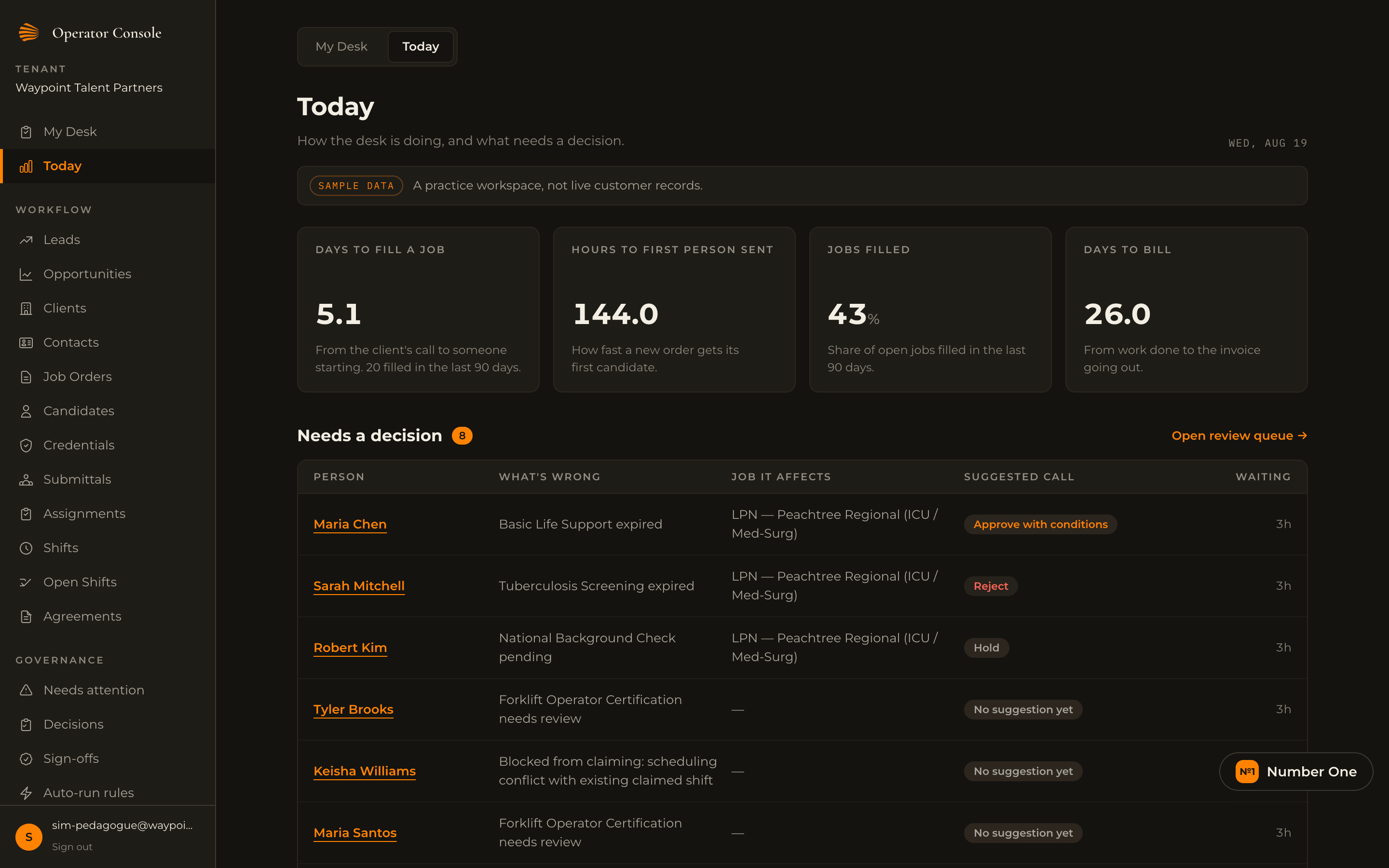
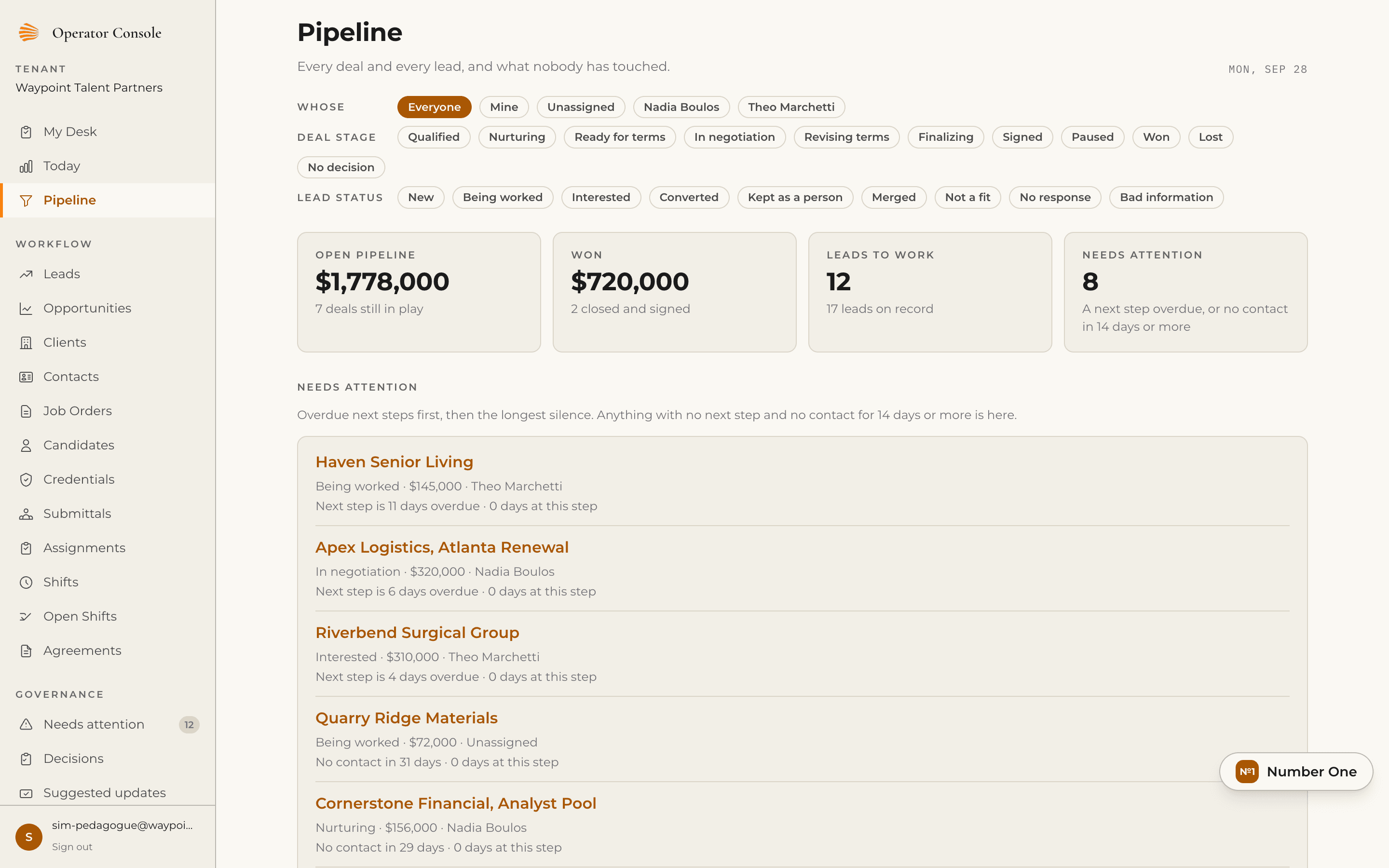
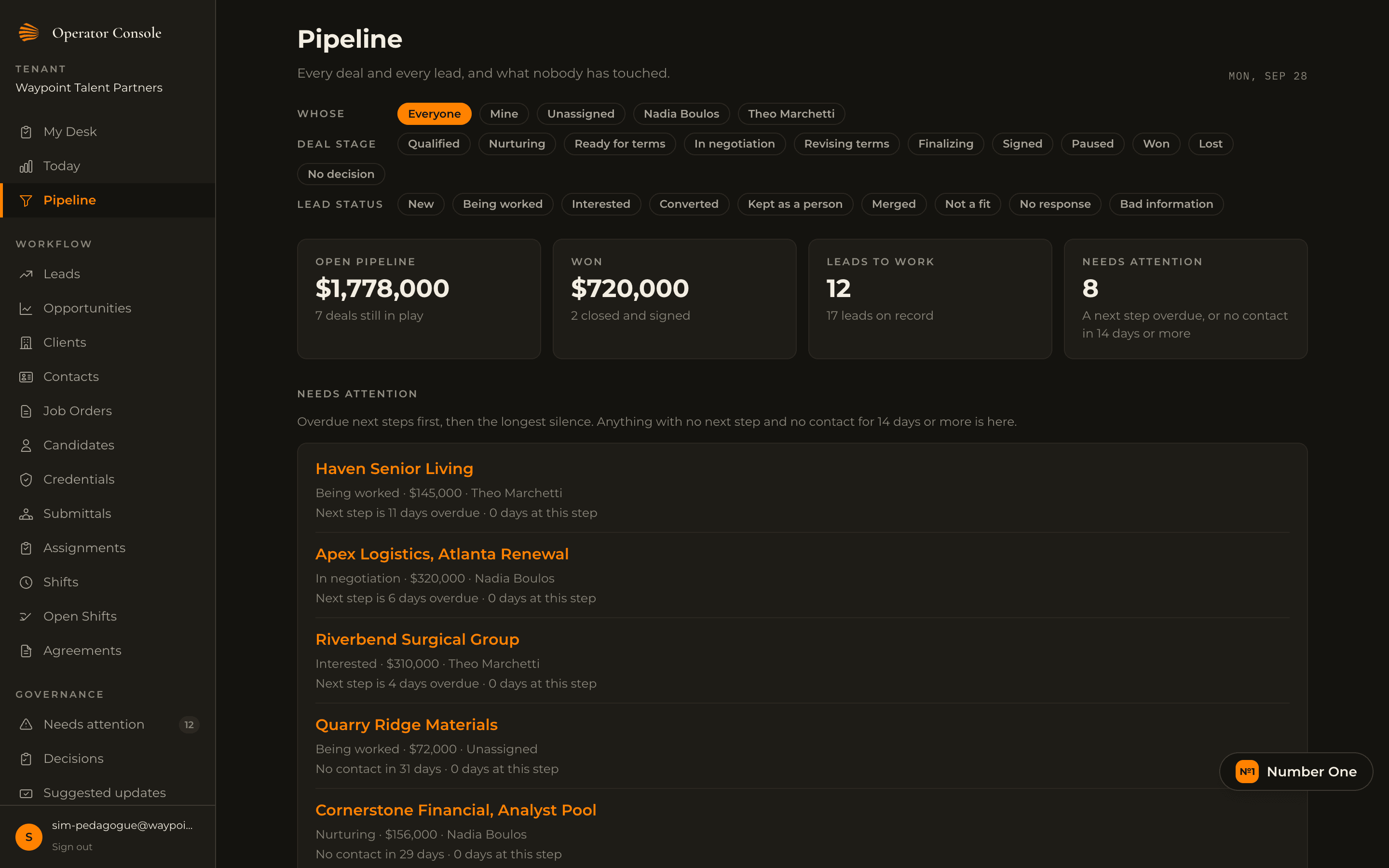
Three screens carry the day. My desk is the work in the order it needs doing. Today is how the desk is performing and what is waiting on a decision. Pipeline is the sales desk: every deal and lead, who owns it, and what has gone quiet.
How a morning goes
The routine work, already done.
A practice workspace, one agency's book of business across healthcare, industrial, and professional placement.
What is waiting
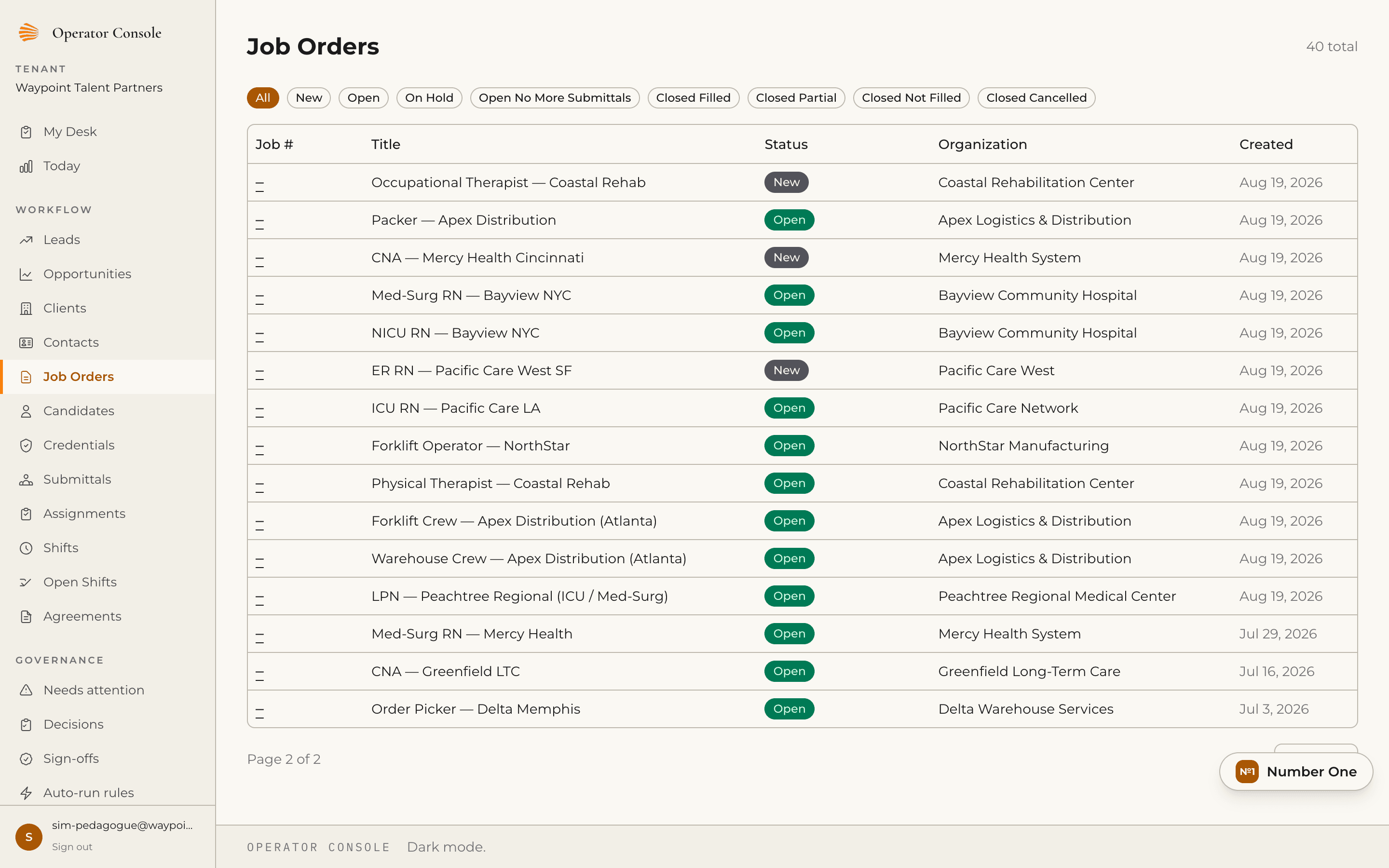
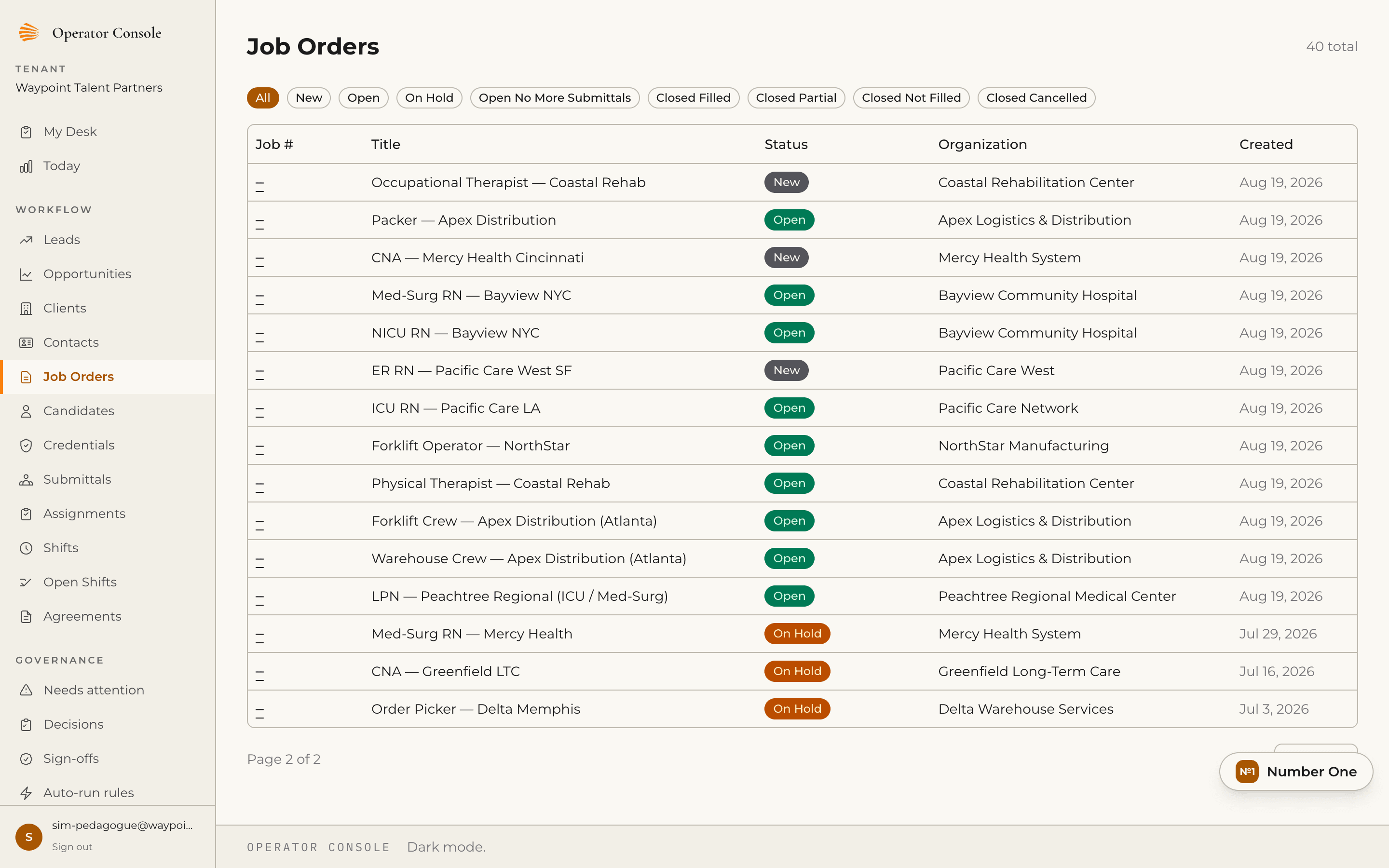
Paperwork waiting to move, workers idle since Friday, leads going cold, orders open for weeks, and a queue of judgment calls nobody has reached. Every stack costs coordinator hours.
What moved on its own
By the time the coordinator opens the console, three stale orders are parked and the paperwork holding up three placements has been routed for review. Each move names the rule your team wrote that authorized it, and each one can be undone.
What routes to a person
An expired certification two weeks from a start date is not routine, so it goes to a person with the requirement, the renewal history, and the order it is blocking on one page. The person decides, and that holds as the automation grows.
What the record shows
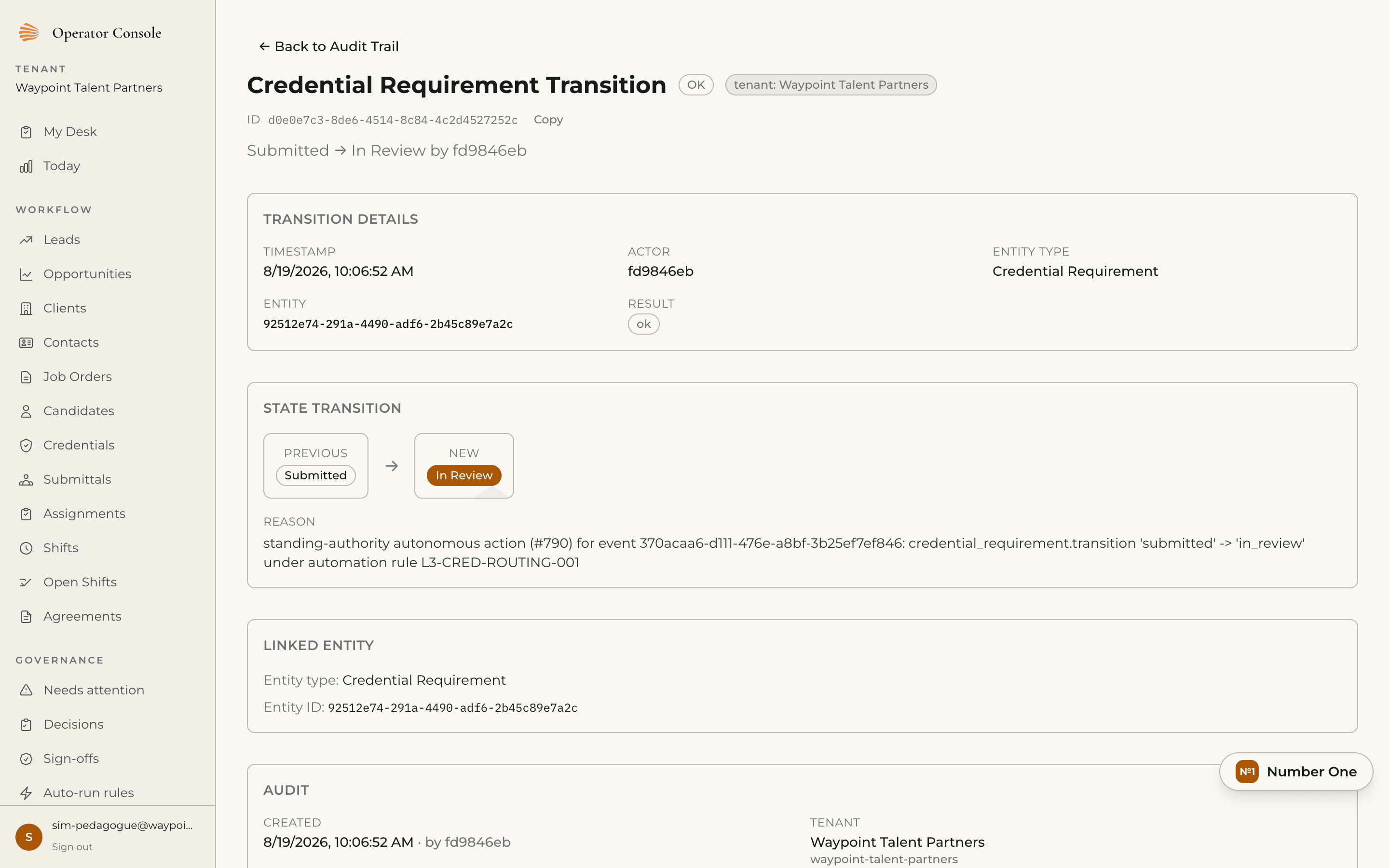
Everything that moved is one query away months or years later: what changed, what changed it, and the rule that authorized it. Refused attempts sit on the same trail with the reason. This is the part that answers an audit.
How it gets set up
The transformation program is what makes this safe.
Before any of it runs in your operation, we assess how your desks actually work and write the rules with your team rather than handing you ours.
Your people decide which transitions a rule may touch and which of those can be undone. That review is the work, and it is why the automation can be trusted once it is on.
How it is built
The rules live in the data.
Business rules are enforced in the database itself, through triggers, functions, and row-level policy. Rules written in an application can be bypassed by anything that talks to the database directly. Rules written as database triggers bind every writer, including the service account the application runs as.
Work advances from one state to the next, and every one of those steps carries an owner, a reason, and a durable audit record, whether a person, a rule, or a model proposed it.
Cassion runs end to end with no AI at all, and every deployment stays runnable that way. Where AI is introduced it runs on top, inside the same triggers and policies as every other writer.
Rules in code can be bypassed. Rules in triggers bind every writer.
How much the AI does
You set the level.
It starts deterministic and does nothing on its own.
Where your team allows it, it drafts work and a person reviews every draft.
Where your team has classified a transition as reversible, it does that routine work on its own, and everything else routes to a person.
Which of those your operation runs is set with your team during the transformation program.
The five guarantees
What holds on every decision.
These guarantees apply to every consequential action in the system, and the application’s own service account is bound like any other writer.
A named person holds it
Every consequential decision has a named person attached to it, and the system never acts alone on anything that matters.
An explicit confirm step
Either that person confirms the action, or that person granted standing authority for the exact transition in advance and the grant sits on the record. Nothing commits outside those two paths.
A durable audit trail
Every confirmed action lands as a queryable row in the audit trail, so you can ask the record questions months or years later.
A worker-readable reason
Any decision affecting a person carries a plain-language reason, written where the person it affects can actually read it.
Rules in the data
Enforcement sits in the database itself, so an AI cannot write outside the rules it was given, and switching that enforcement off is a change to the database rather than an application call.
How it sits in your stack
Keep, replace, add.
You do not have to choose between one suite and best of breed, because Cassion sits underneath the systems you already operate.
Keep what is working
Payroll, background check, and license verification stay where they are, and Cassion orchestrates them rather than replacing them.
Replace the front-office seats
ATS, VMS, and CRM seats can migrate to lighter Pedagogue applications on a shared governance backbone, and we scope those savings as seat savings.
Add the governance layer
The governance layer is the piece no current vendor offers and the piece every AI deployment eventually needs.
The products.
Cassion
The governed data foundation and the system of record for the entire staffing lifecycle, from application through payment.
Compass
The rules layer for matching, where the rules are yours and policy authority remains with you rather than with the model.
Almanak
One product across phone and web, where what a person sees follows their role and their context rather than their device.
Next step
Questions about the platform.
Tell us what you want to know and we will walk you through it.
Ask us about the platform.You will be asked your name, your role, and what brought you here.